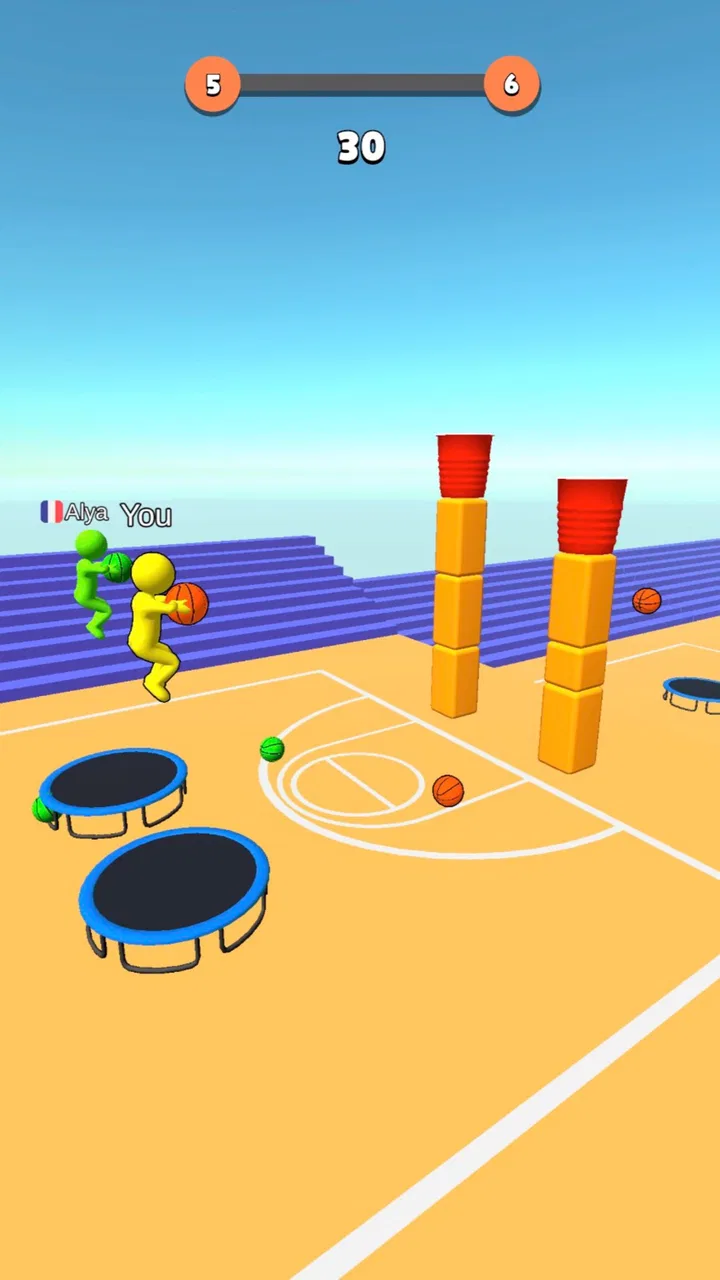
Jump Dunk 3D
- 4.6
- Rating
- 10.00M
- Installs
- Free
- Price

 Analysis by App-foxy
My first impression of Jump Dunk 3D was that it understands the appeal of a quick mobile game: there is one obvious objective, the action starts quickly, and each attempt is short enough to fit into a spare moment. You guide a basketball player through trampoline-assisted jumps and try to send the ball into the cup. That sounds simple, and it is, but the timing gives the game just enough tension to make a successful shot feel earned.
Developed by VOODOO, this free action game is aimed at people who want something light rather than a deep sports simulation. I would not install it expecting realistic basketball rules, team management, or a long career mode. Its appeal is the small challenge in front of you: understand the jump, adjust your timing, and make the ball land where it should. For a first-time player, that clarity is a real advantage.
What to expect when you start playing
The store summary describes the central idea accurately, but it does not explain why the format works. The trampoline changes the shot from a normal throw into a timing puzzle. You are not simply choosing a direction and watching a standard basketball animation. You are watching the character’s movement, judging the moment to release, and learning how the bounce affects the final path.
You May Also Like

 Blood Strike: 2.5 Anniversary
Blood Strike’s Loadouts Turn Every Drop Into a Tactical Gamble
A close look at Blood Strike’s custom loadouts: how fast access to signature weapons reshapes its battle royale rhythm, rewards preparation, and narrows the gap between fights.

 Pandora - Music & Podcasts
Pandora’s Music Is Easy to Start, but Harder to Recover
Pandora’s strength is its low-effort path from a seed to a station. Its weak spot is how much confidence it asks you to place in connection, setup, and quiet recovery.

 8 Ball Pool
 Is Built on Rivalries, Rematches, and Routine
A close look at the rivalries, rematches, shared routines, and unanswered safety questions that turn a quick pool match into a persistent mobile community.

 Samsung Music
’s Quiet Strength Is Playing What You Already Own
Its reach comes less from spectacle than from dependable access to a personal library. That simplicity is both the app’s strongest retention engine and its ceiling.

 AccuWeather: Weather Radar
AccuWeather Review: A Quick, Clear Forecast for Everyday Decisions
For everyday plans, the best forecast is the one you can understand quickly. AccuWeather makes rain timing, radar, and local conditions easy to act on, with a few trade-offs.

 Hill Climb Racing
Why Hill Climb Racing Still Turns Crashes Into One More Run
A tiny car, a bumpy hill and one more upgrade: Hill Climb Racing keeps resurfacing because its simple chaos makes every near-miss feel personal.
More From Our News Desk



That makes the game best suited to short sessions. I can imagine opening it while waiting for a bus, taking a few attempts during a break, or playing for a little while when I want an uncomplicated distraction. It does not demand the concentration of a competitive multiplayer game, yet it still gives me a reason to try again after a miss.
The presentation is deliberately straightforward. The action is easy to understand without a tutorial-heavy introduction, which helps the game get out of the way and let the physical timing carry the experience. The trade-off is that players who prefer detailed explanations, elaborate objectives, or a strong story may find the structure too thin.
Its audience is broad: the content rating is Everyone, and the controls are approachable enough for someone who rarely plays mobile action games. The game is free to download, while optional in-app purchases are listed at $3.49 per item. I would treat those purchases as an extra choice rather than part of the basic reason to try the game.
The game has also reached a substantial audience, with over 10 million installs and an average rating of 4.6 from around 61 thousand ratings. Those figures suggest that its quick, accessible format connects with many players, although popularity does not remove the personal question of whether repeated timing challenges are your kind of entertainment.
Who will enjoy the format most
I think it works especially well for players who like compact arcade challenges. If you enjoy repeating a simple action until your timing improves, the trampoline and basket combination gives you a clear skill to practice. It is also a good choice for someone who wants a sports-themed game without learning a full set of rules.
On the other hand, I would skip it if your main reason for downloading a basketball game is to control an entire team, compete through a detailed season, or build a player over time. A basketball simulation or a larger sports title would be a better match for those goals. This game is closer to a focused arcade toy than a complete basketball experience.
Getting through the first setup and first attempt
The technical entry point is modest. The current version is 3.3.29, and it requires Android 8.0 or later. That makes checking the operating system the only practical compatibility step I would take before installing. Once it is on a compatible device, the useful approach is not to overthink the opening screen. Start playing and use the first few attempts to observe the rhythm rather than chasing an immediate perfect result.
For a new player, the first meaningful success should be treated as a learning exercise. Watch how the character approaches the trampoline, notice when the body reaches the useful part of the jump, and release with a deliberate motion. If the ball misses, do not change everything at once. Adjust one thing on the next attempt, such as releasing slightly earlier or later, so you can tell which change helped.
This is one of the more important habits in the game: use misses as timing information instead of randomizing every attempt. Because the objective is so focused, a small adjustment is easier to evaluate than it would be in a complicated sports game. I found that thinking in terms of rhythm made the action feel less frustrating than simply swiping again and hoping.
A practical first-session routine is to spend the opening attempts watching the bounce, then concentrate on the release point, and only after that worry about speed. New players often want to act immediately because the game looks simple. In reality, a moment of observation can be more useful than a fast, uncertain gesture.
How I approach the first successful shot
I begin by keeping my attention on the relationship between the trampoline and the cup, not on the character’s appearance or the background. The important question is where the bounce places the player in relation to the target. Once that position makes sense, I make a controlled attempt rather than a hurried one.
If the ball travels too far, I make a smaller adjustment on the next try. If it falls short, I change the timing in the opposite direction. This sounds obvious, but it prevents the most common beginner mistake: making a dramatic correction after every miss. With a game built around repeated short attempts, consistency matters more than a single lucky throw.
Another useful tip is to keep the phone steady. This is not because the game requires complicated physical movement, but because a stable grip makes your input easier to repeat. When I hold the device comfortably and use the same general gesture each time, I can compare attempts more clearly. That turns the opening minutes into a simple experiment rather than a guessing game.
The first successful basket is satisfying precisely because it confirms that the timing is understandable. It does not require advanced basketball knowledge. You do not need to know professional shooting technique or memorize a playbook. You need to recognize the game’s movement and respond at the right moment.
Confusion that can make the game feel harder
The biggest source of confusion is assuming that the game should behave like a standard basketball title. In a simulation, I might think about distance, defensive pressure, shot selection, and player attributes. Here, the trampoline is the central mechanic, so the useful mental model is closer to an arcade timing challenge. Once I stop expecting realistic basketball behavior, the design becomes easier to read.
Another misunderstanding is believing that a miss automatically means the direction was completely wrong. Sometimes the direction is close and the timing is the real issue. I recommend changing only one part of the attempt at a time. If you alter the release, gesture, and position together, a successful result will not teach you much about what actually worked.
It is also easy to rush because each attempt is brief. That can create a cycle in which I make a quick move, miss, immediately repeat the same rushed habit, and then blame the game. A better approach is to pause for a second after an unsuccessful attempt, identify whether the ball went short or long, and make a measured correction.
Players may also wonder whether they need to spend money to enjoy the basic experience. Since the game is free and the listed purchases are optional items, I would first play it without buying anything. That gives you a fair test of whether the core jumping and dunking loop holds your attention. If you already dislike repeated arcade attempts, a purchase is unlikely to solve that problem.
The age rating makes it suitable for a general audience, but “Everyone” should not be confused with “ideal for everyone.” Younger players may appreciate the simple goal, while adults looking for a demanding sports game may find it too limited. The rating describes accessibility, not depth or complexity.
How it compares with other mobile basketball choices
Compared with a full basketball simulation, this game is much easier to pick up. There are no teams, formations, long matches, or extensive rule decisions competing for attention. That makes it the better option when I want a quick challenge and do not want to invest time learning a larger system.
Compared with a generic endless runner, it offers a more focused objective. The player is not simply avoiding obstacles for as long as possible; the target is visible, and the action is tied to a recognizable basketball moment. That gives each attempt a clearer sense of purpose, even though the overall structure remains lightweight.
Compared with physics puzzle games, it shares the satisfaction of adjusting an action after failure, but it keeps the interaction more immediate. There is less planning and more reaction. If you enjoy carefully building solutions over several minutes, another puzzle game may offer greater depth. If you prefer quick feedback and short retries, this is likely the stronger fit.
The most important trade-off is variety versus accessibility. The focused design helps a first-time user understand the objective almost instantly, but it can also become repetitive for players who need many different modes to stay interested. I would recommend it as a casual side game, not as the only game on a phone.
Making the next session more useful
After the first successful shot, I would not immediately chase speed. I would try to reproduce the result with a similar rhythm. Repetition is valuable here because it separates a reliable technique from a lucky attempt. Once the movement feels familiar, I can begin making smaller timing changes and see how precisely I can control the outcome.
A helpful everyday use case is a short waiting period with no desire to start something demanding. I can play a few attempts, put the phone away, and return later without needing to remember a complicated story or strategy. That makes the game convenient for fragmented free time. It is less suitable for a long uninterrupted session if repeated attempts begin to feel like work rather than fun.
I would also keep expectations realistic about progression. The core pleasure comes from improving the shot and handling the challenge in front of you, not from treating the game as a substitute for a full sports career. If you want a relaxing arcade loop, that focus is a strength. If you want deep long-term goals, it is a limitation you should recognize before installing.
The developer’s choice to keep the premise so direct means the game is easy to recommend selectively. I would suggest it to a friend who wants a free, accessible action game with a basketball theme and short attempts. I would not recommend it to someone who dislikes retry-based play, wants realistic basketball controls, or expects a large amount of content beyond the central mechanic.
My final advice is to give the game a fair first session: play slowly enough to understand the bounce, change one variable after a miss, and decide based on whether improving your timing feels satisfying. Jump Dunk 3D is at its best when approached as a small arcade challenge rather than a complete basketball game. For that specific purpose, it is simple, approachable, and easy to return to when I have only a few minutes to spare.
FAQs for Jump Dunk 3D
01What is Jump Dunk 3D?
Jump Dunk 3D is an engaging and dynamic mobile game available on both Android and iOS platforms. It combines elements of basketball and platform jumping, challenging players to shoot hoops while navigating through various obstacles. With intuitive controls and colorful graphics, it offers a fun and addictive experience for casual gamers.
02How do the controls work in Jump Dunk 3D?
The controls in Jump Dunk 3D are designed to be simple and intuitive, perfect for touch screens. Players swipe to adjust the trajectory of their shots and tap to jump. Mastering these controls is key to advancing through levels and achieving high scores, making the game accessible yet challenging.
03Is Jump Dunk 3D free to play?
Yes, Jump Dunk 3D is free to download and play. However, like many mobile games, it offers in-app purchases. These purchases may include items like special balls, power-ups, or ad removal options. Players can enjoy the game without spending money, but purchases can enhance the gaming experience.
04Does Jump Dunk 3D require an internet connection?
Jump Dunk 3D can be played both online and offline. An internet connection is required for certain features, such as accessing leaderboards or making in-app purchases. However, the core gameplay does not require an internet connection, allowing players to enjoy it anytime, anywhere.
05Are there any age restrictions for playing Jump Dunk 3D?
Jump Dunk 3D is suitable for a wide range of ages, typically rated for players aged 4 and up. Its colorful graphics and straightforward gameplay make it appealing to children, while the increasing difficulty levels provide a challenge for older players. Parents can feel confident about its family-friendly content.
Pros
- Engaging and intuitive controls.
- Variety of challenging levels.
- Colorful and vibrant graphics.
- Smooth performance on most devices.
- Offline play available.
Cons
- Repetitive background music.
- In-app purchases can be pricey.
- Limited customization options.
- Advertisements can be intrusive.
- Occasional lag on older devices.

Jump Dunk 3D
Gallery